Stock Market News Today USA — March 28, 2026: Key Trends & What Investors Need to Know
If you’re looking for the latest stock market news today in the USA, March 28, 2026 brings some deeply concerning headlines for investors. Wall Street closed out the week on a brutal note, with all three major indexes posting sharp losses as the US-Iran war continues to batter energy markets, push oil prices to alarming heights, and fuel fears of stagflation. The Dow Jones entered correction territory, the S&P 500 hit a seven-month low, and the Nasdaq extended its slide deep into correction territory. Here is a complete breakdown of everything moving markets right now — and what investors should watch heading into next week.
1. Dow Jones Enters Correction Territory — Down 793 Points Friday
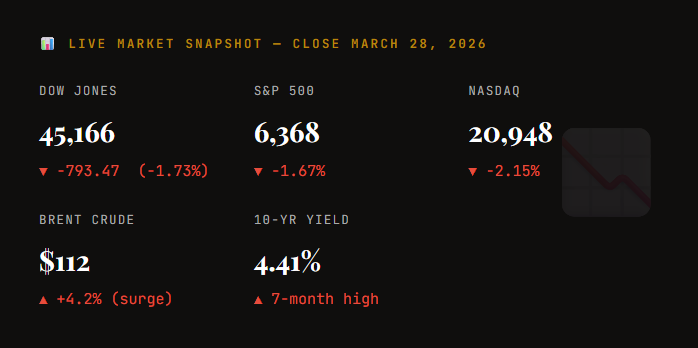
The headline number from Friday’s session is impossible to ignore. The Dow Jones Industrial Average lost 793.47 points, or 1.73%, to end the session at 45,166.64. The S&P 500 dropped 1.67% to close at 6,368.85, and the Nasdaq Composite declined 2.15% to finish at 20,948.36.
The damage runs even deeper on a weekly and monthly basis. All three major averages have each fallen more than 7% month to date. Wall Street traders drove stocks to their longest weekly slide since 2022 on concern that a protracted war in Iran will keep oil prices elevated, fueling an increase in inflation and a slowdown in growth.
For everyday investors, these numbers translate into real losses in 401(k)s, retirement accounts, and portfolios. The mood on Wall Street right now is one of deep uncertainty — and for good reason.
2. The Iran War Is the #1 Driver of Market Volatility
Ask any analyst what is causing the market turmoil, and the answer is the same: the US-Iran war. The conflict has an extensive impact not just directly on LNG and oil, but also on other commodities such as sulphur, urea, ammonia, and aluminum — and then there are second-order effects, the greatest of which is Asia’s dependency on jet fuel and diesel from the Middle East.
The Strait of Hormuz — through which a massive share of global energy flows — remains a flashpoint. The longer the Strait is closed, the worse the oil market is going to get. Even if a resolution is reached, if it takes another month to reopen, oil might stay elevated for an extended period until inventory stocks can be rebuilt.
Trump extended his strike deadline against Iran’s energy infrastructure to April 6, saying the extension came at the request of Iran’s government and that diplomatic talks were ongoing. But markets were skeptical. One prominent analyst said there is “no obvious catalyst for good news in the next few days,” adding that Iran appears intent on maintaining an aggressive tone, at least publicly.
3. Oil Prices Surge Past $110 — Brent Tops $112
Energy prices are at the heart of the market crisis. Brent crude topped $112 per barrel this week — a level not seen in years — and one that is rippling through every corner of the economy, from airline tickets to grocery bills.
Macquarie Group analysts raised their oil price outlook for fiscal 2026, with West Texas Intermediate averaging around $83 per barrel, up sharply from $58 per barrel, citing the large supply disruption caused by the Middle East conflict. For American consumers, the impact is already being felt at the gas pump. For businesses, rising energy costs are squeezing margins and forcing difficult decisions on pricing and hiring.
4. Nasdaq Falls Into Correction — Tech Stocks Hit Hard
One of the most significant market milestones of the week is the Nasdaq’s slide into correction territory — down over 10% from its peak. Several major tech stocks have been particularly hard hit.
Micron Technology slid for a sixth consecutive day and fell 22% from its recent all-time high, dragged down in part by Alphabet’s introduction of the TurboQuant AI compression algorithm, which raised concerns about memory chip demand. Meta suffered an 8% loss on the back of its legal woes, contributing to the Nasdaq’s worst day since October.
Meanwhile, Nvidia has dropped more than 10% in 2026, reversing course after years of extraordinary gains — though analysts at Wolfe Research argue the company’s new compute racks represent significant revenue opportunities that the market is not yet fully pricing in.
5. The Stagflation Warning — Rising Yields Sound the Alarm
Beyond the day-to-day market moves, there is a deeper and more troubling signal emerging from the bond market. The 10-year Treasury yield extended its recent climb, closing at 4.41% — its highest level since July 28, 2025 — and rising yields in this environment signal the growing danger of stagflation, which will be a significant headwind even when a solution for Iran is finally reached.
Stagflation — the toxic combination of stagnant economic growth and elevated inflation — is the nightmare scenario for the Federal Reserve. Federal Reserve officials left interest rates unchanged at their March meeting and continued to expect one rate cut this year, as they acknowledged increased uncertainty due to the war in the Middle East.
Philadelphia Fed President Anna Paulson said that the current state of inflation running above the central bank’s 2% target is making her more apprehensive about policy, and that if inflation were at target, she would feel more comfortable being patient and keeping monetary policy on hold.
6. What to Watch Next Week: March 30 – April 3, 2026
Despite the gloom, investors have a packed calendar to navigate in the week ahead. Key data releases include Consumer Confidence on Tuesday, the ADP Employment Survey and ISM Manufacturing on Wednesday, and the monthly jobs report — with the unemployment rate expected to hold at 4.4% — on Friday, though markets will be closed for Good Friday.
Earnings season also continues, with Nike and McCormick & Co. reporting on Tuesday and Conagra Brands on Wednesday.
Seasonally, there is some good news: April historically marks the end of the best six months for the stock market, and it is typically the second-best month for the Dow Jones Industrial Average, which has averaged a 1.8% yearly gain in April going back to 1950. Whether history repeats itself will depend heavily on whether Trump’s Iran deadline on April 6 leads to a resolution — or an escalation.
Quick Facts: US Stock Market — March 28, 2026
| Index / Asset | Close | Daily Change | Status |
|---|---|---|---|
| Dow Jones | 45,166.64 | −1.73% | Correction |
| S&P 500 | 6,368.85 | −1.67% | 7-Month Low |
| Nasdaq | 20,948.36 | −2.15% | Correction |
| Brent Crude | $112 / bbl | ▲ Surge | Multi-year High |
| 10-Yr Treasury Yield | 4.41% | ▲ Rising | 7-Month High |
Final Thoughts
The US stock market is navigating one of its most turbulent stretches since 2022. The Iran war, surging oil prices, a government shutdown, Nasdaq correction, and stagflation fears have created a perfect storm for investors. With Trump’s April 6 Iran deadline looming and key economic data due next week, volatility is unlikely to fade quickly. Stay informed, stay diversified, and check back with CelebTrend daily for the latest stock market news and financial updates.